I build the tools fraud investigators search with.
I'm David Valor, a full-stack engineer. Since 2021 I've kept an open-source intelligence (OSINT) investigation platform in production: one search queries 15 sources, a graph connects what they return, and an AI assistant reads it.
Fictional data. The real product belongs to Grupo Analytiko and its cases are confidential.
- 15
- external sources queried by a single search
- 1,800+
- commits of mine in the OSINT codebase since 2021
- 11
- cloud services behind one API
- 5
- years keeping the same system in production







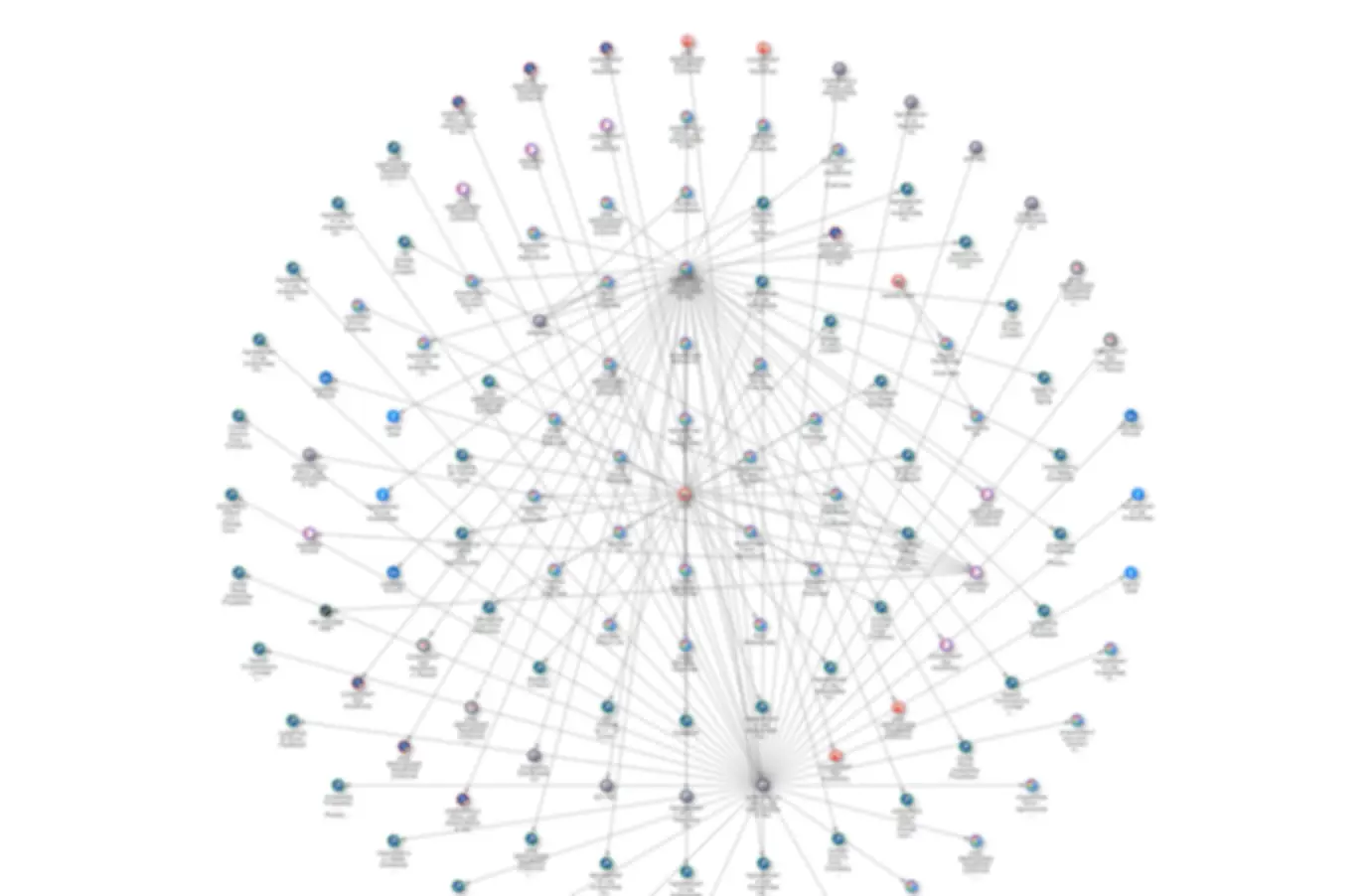
An investigator types a name, a phone number or a username. The platform queries sanctions lists, official gazettes, court rulings, social networks and the web at the same time, and draws what it finds as a graph they can keep exploring.
How one search travels
- Confirm the connectionThe browser asks for an acknowledgement before it sends anything that costs credits.
- Fan outOne adapter per source. All leave in parallel and none waits for another.
- Stream backEach result arrives over a socket, tagged with its search id, as soon as it exists.
- Draw the graphEach result becomes a typed node. The type declares which searches it can trigger next.
- Charge onceOne search uses one credit, even if a source fails or the page has to reconnect.
An assistant that reads the graph
I added a conversational assistant over the relationship graph. The model filtering runs on the server, so the investigator asks in plain language and the model only sees the nodes of the case that is open.
Tested against the real thing
I wrote the project's first end-to-end suite with Playwright: it exercises all 15 search APIs on a deployed environment. At the August 2026 production close-out the project ran 1,149 backend tests and 359 frontend tests.
Web results in about a second
I packaged the web crawler into a single Cloud Run image to stop paying for the external service. Search used to take over 30 seconds and sometimes came back empty; it now answers in about 1 second, and each page's content is fetched later, when the investigator adds it to the graph.
What a search costs
I measured it over 30 days in 2026: a full search across every source costs 5.5 US cents in infrastructure, and a search on a person costs 0.2 cents. Three sources account for 96% of that cost, which shows where to optimize.
What broke in production, and how I fixed it
Watch each failure happen step by step, then switch the fix on. All three are real.
A fraud case is thousands of transfers. Analyst draws them as a graph of accounts and answers the questions an analyst asks: who moves the most, who connects everyone, and where the money stops.
Eight fictional accounts. The rankings are computed in your browser with the same definitions the analysis endpoints use.
Questions an agent can ask too
Each ranking is an endpoint with an exact definition. That lets an AI agent run the first pass on a case with the same queries the analyst uses, and makes every conclusion auditable.
Data that arrives on its own
I built the scheduled ingestion of operations and rates that feeds the analysis. For confidentiality I don't show the client or its data.
Before signing with a supplier, a client or a partner, someone in compliance has to check them. DDR looks them up in sanctions, watchlists, lists of politically exposed persons (PEP) and the news, and shows what matched and why, so a person makes the call.
What you hand in
- Name
- Orinoco Trading, C.A.
- Document
- J-00000712-4
- Keywords
- imports, customs
What DDR checks
- Sanctions lists
- Watchlists
- Politically exposed persons
- News, classified with AI
What you get back
Complete report as a PDFEvery match with its reason and source, a folio and a QR to verify it
Fictional document and company. Below you can open the report in three scenarios.
Fictional counterparties, folios and news. The status wording is the one the product uses.
The AI flags, a person decides
Lists are checked with no AI at all. For news, a small model classifies each item and estimates whether it is about the same person, with the reason written down. A larger model steps in only when that identity is doubtful. No news item changes the report status.
A certificate anyone can verify
Each check produces a PDF with a folio and a QR code. Whoever receives it scans the code and confirms the certificate is authentic, without seeing the result. Every check is written to the audit log with the document masked.
I built the sources too
Several of the sources the platform queries are services of their own. Two have public code.
Sanctions screening
It loads the OpenSanctions open data into MongoDB and serves it as an API. Search ignores accents and case, because a misspelled name must not let a sanctioned person through. Doubtful matches go to a model that writes down its reason for the audit trail.
No match in this fictional list.
Official gazettes
It downloads the PDFs of Venezuela's Official Gazette archive, extracts the text page by page and indexes it. A search by name then finds appointments, companies and penalties published years ago in scanned documents.
…se designa al ciudadano JOSÉ Á. PEÑALVER como director de la sociedad mercantil ORINOCO TRADING, C.A.…
- DownloadScanned PDF, 48 pages
- Read (OCR)Text extracted page by page
- IndexEvery page becomes searchable by name
- Hit"penalver" → 2016 gazette, page 14
Fictional document. Real gazettes are in Spanish.
Court rulings
It extracts the people named in supreme court decisions and makes them searchable by name, so a court record shows up in the same graph as every other finding.
…vista la demanda interpuesta por CARIBE LOGISTICS, C.A. contra el ciudadano EDUARDO MARCANO, asistido por la abogada MARÍA URDANETA, esta Sala declara…
Fictional ruling. Tap or point at a name to see where it appears.
Other work
Compliance, computer vision, logistics and AI automation.
- Smart ComplianceReact, GraphQL and Lambdas that validate environmental control rules.
- AI content pipeline500+ pages with semantic deduplication and human review.
- PTZ-3DComputer vision and remote camera calibration.
- Atenea / DiXtraReal-time dispatch and fleet operations.
- AltyroLogistics, scheduling and payment integration.
- RAG platform architectureA design exercise, not a production system.

About
I've been developing software since 2017 and integrating generative AI into products since 2023. I work across the whole delivery: the interface, the APIs, the integrations, the tests and what breaks in production.
My core stack is TypeScript, Node.js, Python, Angular and React, on Google Cloud and AWS. What I know best is the domain: fraud investigation, sanctions and compliance.
Does your team investigate fraud or run customer checks (KYC)?
Tell me which sources you check by hand today and what keeps breaking. I reply within one business day.